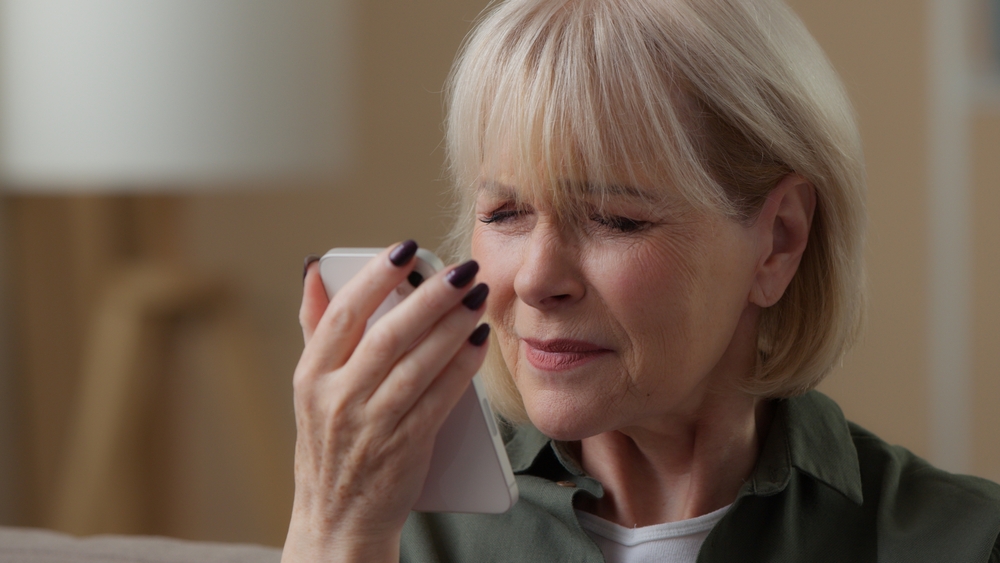
Holding your phone at arm’s length just to read a text message is one of the clearest signs that your near vision is starting to change. Struggling to make out a menu in dim restaurant lighting is often close behind.
This gradual shift, called presbyopia, happens to almost everyone eventually, no matter how sharp your eyesight has been up to this point. It develops when the lens inside the eye slowly loses the flexibility it needs to focus up close.
Keep reading to learn why near vision loss is so universal and what you can do about it beyond reaching for a stronger pair of reading glasses!
What Is Presbyopia?
Presbyopia is the medical term for the gradual loss of near vision that occurs as the eye ages. Unlike nearsightedness or farsightedness, which are refractive errors present from a young age, presbyopia develops later in life as a natural result of the aging process.
Inside the eye, a flexible lens changes shape to help you focus on objects at different distances. Over time, that lens becomes stiffer and less able to shift shape. When the lens cannot adjust quickly enough for close-up tasks like reading or texting, images up close appear blurry while distance vision often stays sharp.
Presbyopia is often confused with cataracts since both become more common with age, but they are different conditions. Cataracts cloud the lens and affect vision at every distance, while presbyopia is specifically about the lens losing its ability to flex for near focus. An eye doctor can determine which condition, or combination of conditions, is affecting your vision.
Is It Really True That Everyone Experiences Presbyopia?
Yes. Presbyopia is one of the few eye conditions that affects nearly every person who lives long enough to experience it. It does not discriminate based on how healthy your eyes have been throughout your life or whether you have ever worn glasses before.
A history of 20/20 vision or a previous LASIK procedure offers no protection from presbyopia, since the lens hardening behind it is unrelated to the refractive errors those treatments correct. Even so, presbyopia does not have to mean a lifetime of reading glasses. Many patients are surprised to learn they can significantly reduce or even eliminate their dependence on readers.
When Does Near Vision Typically Start to Change?
Most people begin noticing symptoms of presbyopia in their early to mid-40s. The change often feels sudden, though it has actually been developing gradually for years before symptoms become noticeable enough to affect daily tasks.
Near vision continues to decline through your 50s and generally stabilizes by your mid-60s once the lens has lost most of its flexibility. This timeline is remarkably consistent across the population, which is part of why eye doctors consider presbyopia a predictable stage of aging rather than a disease to prevent.
Signs Your Near Vision Is Slipping

The symptoms of presbyopia tend to show up gradually during everyday tasks.
Common signs include:
- Holding books, menus, or your phone farther away to bring text into focus
- Needing brighter light to read comfortably, especially in the evening
- Experiencing headaches or eye strain after extended close-up work
- Struggling to switch focus quickly between near and distant objects
If these symptoms sound familiar, an eye exam can confirm whether presbyopia is the cause and rule out other conditions that affect near vision. For many patients, these symptoms are the reason they schedule their first eye exam in years, even though presbyopia itself is unrelated to more serious concerns like cataracts or glaucoma.
Reading Glasses Aren’t Your Only Path Forward
Reading glasses are the most common first step for managing presbyopia, and for many people they work well enough for years. Some patients, however, find the constant searching for their glasses and swapping them on and off throughout the day more frustrating than helpful.
Refractive lens exchange offers a surgical alternative for patients who want to reduce their dependence on reading glasses. During the procedure, the eye’s stiffened natural lens is replaced with an artificial lens designed to restore a fuller range of vision. Patients who have refractive lens exchange often describe the freedom of not needing to reach for readers every time they pick up a book or check a text message.
Recovery from refractive lens exchange is typically quick, with many patients resuming normal activities within a day or two. Recovery from refractive lens exchange is typically quick, with many patients resuming normal activities within a day or two.
Also, because the procedure removes the eye’s natural lens, it also eliminates the possibility of ever developing a cataract in that eye, since cataracts can only form in the lens being replaced.
Seeing Clearly Doesn’t Have to Wait

Losing some near vision is one of the most universal changes your eyes will go through, and it happens to nearly everyone eventually. That does not mean your options are limited to a drawer full of reading glasses in every room of your house.
Patients in Austin have more choices today than ever before for addressing presbyopia at its source. Dell Laser Consultants specializes in matching each patient with a solution that fits their vision and their life, whether that means a simple pair of readers or a permanent change to how they see the world up close. Whichever path fits you best, an eye exam is the right place to start figuring out what your near vision needs.
Have you noticed your near vision changing? Schedule a consultation at Dell Laser Consultants in Austin, TX, today!